
Some women in the Bible were pillars of grace and strength. Others… well, let’s just say they were on a completely different level.
They didn’t just make mistakes; they made choices that were chilling, calculated, and flat-out evil. When you read their stories, you don’t just pause—you feel a genuine shiver.
Wait… she really did that to her own family? She actually asked for a head on a platter?
It’s heavy stuff, but it’s part of the raw honesty of Scripture. The Bible doesn’t shy away from the dark side of human nature. It shows us exactly what happens when pride, greed, and a thirst for power take the driver’s seat.
We will be looking at 7 “crazy evil” women in the Bible—women whose actions were extraordinary in their cruelty and whose stories serve as a powerful warning for us today.
If you prefer crazy good stories of faith i recommend this read: 7 Crazy Women in the Bible and What We Can Learn from Them
1. Jezebel: The Queen of Cold-Blooded Cruelty
If there was a Hall of Fame for biblical villains, Jezebel would have her own wing. She wasn’t just “mean”; she was a powerhouse of manipulation and murder. When her husband, King Ahab, was pouting because a man named Naboth wouldn’t sell him his vineyard, Jezebel didn’t offer a pep talk.
She orchestrated a fake trial, hired liars to testify against Naboth, and had him stoned to death just so her husband could have a new garden. Yikes… talk about a “toxic” spouse!
She spent her life trying to wipe out the prophets of God and promoting horrific idol worship. Her story ends as violently as she lived, and it serves as the ultimate “what not to do” for anyone in a position of power.
What we can learn from Jezebel
- Power without principle always leads to destruction
- Manipulation may get you what you want, but it costs you your soul
- Your influence on others is a heavy responsibility—use it for good
2. Athaliah: The Grandmother from Hell
You think you’ve heard of family drama? Athaliah takes it to a level that sounds like a dark thriller movie. When her son, the King of Judah, died, she didn’t go into mourning. Instead, she decided she wanted the throne for herself.
Her solution? She ordered the execution of her own grandsons. Wait… say what?? She tried to wipe out her entire family line just to keep the crown. She almost succeeded, too, if it weren’t for a brave aunt who hid one baby (Joash) in the temple.
Athaliah ruled with an iron fist for six years until the truth came out. Her story is a terrifying look at what happens when the love of power replaces the love of family.
What we can learn from Athaliah
- Greed can blind you to the value of the people closest to you
- Evil plans may seem to succeed for a season, but truth eventually surfaces
- One person’s courage (like Jehosheba saving Joash) can stop a cycle of evil
3. Herodias: The Grudge-Holder Who Wanted a Head
Some people have a hard time letting things go, but Herodias took “holding a grudge” to a murderous extreme. John the Baptist had publicly called out her marriage to Herod Antipas as unlawful, and she never forgot it.
She didn’t just want him silenced; she wanted him gone. During a birthday party, she coached her daughter to dance for the King and then—when offered anything she wanted—to ask for John the Baptist’s head on a platter.
Girl, that is beyond crazy! She used her own child as a tool for murder just to satisfy her pride. It’s one of the most gruesome moments in the New Testament.
What we can learn from Herodias
- Unresolved bitterness is a poison that eventually leaks onto others
- Using people as tools for your own agenda is a fast track to ruin
- A “win” fueled by hate is never actually a victory
4. Potiphar’s Wife: The Original Master Manipulator
We don’t even know her name, but her actions in Genesis 39 speak for themselves. She was a woman of high status who decided she wanted Joseph, one of her husband’s servants. When Joseph—who was a man of huge integrity—refused her advances, she didn’t just take the “no” and move on.
She flipped the script, grabbed his cloak, and lied to her husband and the entire household, claiming Joseph had attacked her. She nearly ruined an innocent man’s life just because she couldn’t handle being told no. Her “crazy” was fueled by entitlement and a total lack of conscience.
What we can learn from Potiphar’s Wife
- Entitlement makes you feel justified in hurting innocent people
- Lies might provide a temporary cover, but they don’t change the facts
- Character is revealed by how you handle “no”
5. Delilah: The Girl Who Sold Out Her Heart
Delilah is the ultimate cautionary tale about “love” with a price tag. She knew Samson loved her, and she used that intimacy as a weapon. The leaders of the Philistines offered her a massive payday—thousands of pieces of silver—to find out the secret of his strength.
She nagged, she guilt-tripped, and she played with his emotions until he finally broke and told her the truth. And what did she do the second he fell asleep? She called in the enemies to shave his head and capture him. That’s cold! She valued a paycheck more than the man she was with. For Delilah, everything had a price, including her loyalty.
What we can learn from Delilah
- Greed is a wedge that can break even the strongest bonds
- Loyalty is worth more than any amount of silver
- Be careful who you trust with your “secret strength”
6. Sapphira: The Partner in Deception
Sapphira’s story in Acts 5 is a tragic look at what happens when you care more about money and “looking” holy than actually being honest. She and her husband, Ananias, sold a piece of land and told everyone they were giving the full amount to the church. In reality, they kept some for themselves.
Now, keeping some wasn’t the sin—it was their land! The “crazy evil” part was the calculated lie.
They wanted the applause of the crowd without the sacrifice of the gift. It also showed that they didn’t fear God. Because if they did they would think twice before lying before God and men.
When Peter questioned her, she looked him in the face and doubled down on the lie. She chose to be a partner in a scam rather than a partner in the truth.
There is a lot of debate on whether Ananias and Sapphira were even Christians because the actions don’t match up.
What we can learn from Sapphira
- Integrity is what you do when you think no one is looking
- It is dangerous to try and “perform” for God while hiding a lie. He knows and sees all.
- Your community is only as strong as its honesty
7. The Two Mothers of Samaria: A Horror Story of Desperation
This story in 2 Kings 6 is probably the most “wait… she did WHAT?” moment in the entire Bible. During a horrific famine and siege in Samaria, two women made a deal. They were so desperate and their hearts had become so hardened by their circumstances that they agreed to eat their own children.
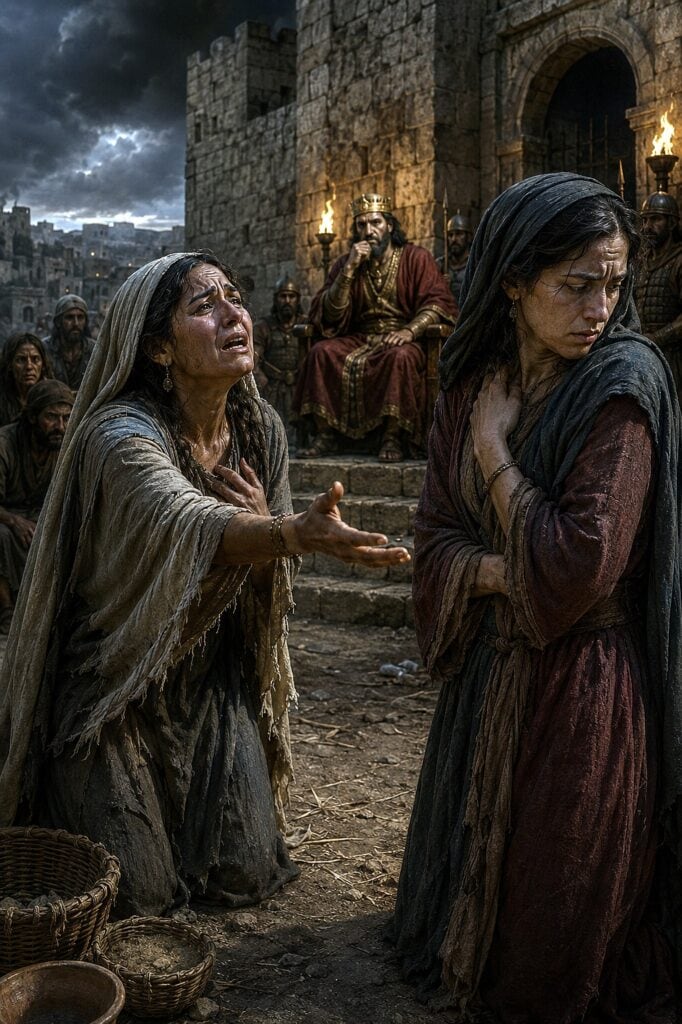
One mother followed through on the first day, but on the second day, the other mother hid her son. It is a stomach-turning account of how far humanity can fall when God is abandoned and total darkness takes over. It’s not just “crazy”—it’s a haunting reminder of the chaos that ensues when a society loses its moral compass.
Why These Dark Stories Still Matter
It can be tempting to read about women like Jezebel or Athaliah and think, “I could never be like that.” And hopefully, that’s true!
But the reason these stories are preserved in Scripture isn’t just to give us a gallery of villains to point at. It’s because the same human heart that was capable of Jael’s courage is also capable of Delilah’s greed.
These “crazy evil” accounts act as a necessary mirror, showing us the logical end of pride, bitterness, and the thirst for control.
They remind us that the choices we make in the quiet moments—how we handle a “no,” how we treat our family, or how we value money—eventually shape the legacy we leave behind.
The Contrast of the Human Heart
I honestly find it fascinating how the Bible places these stories side-by-side with women of incredible faith. It shows us that being “extraordinary” or “unforgettable” can go one of two ways. You can be extraordinary in your devotion, like Mary of Bethany, or you can be extraordinary in your destruction, like Jezebel.
The common thread is that none of these women were passive. They were all bold, but their boldness was anchored in very different places. One sought to honor God, while the other sought to replace Him. It really makes you stop and think about where your own “boldness” is rooted.
Final Thoughts on These Crazy Evil Women
The Bible is beautifully honest about the fact that life is messy and people can be truly dangerous. While reading about the two mothers in Samaria or the calculated lies of Sapphira might feel heavy, it’s a weight that pushes us toward a deeper need for grace.
We don’t study these women to become experts in “evil”; we study them to recognize the warning signs in our own souls. These stories aren’t just ancient history; they are a call to live with integrity, to choose loyalty over silver, and to remember that God sees the heart behind the mask.
So, as we close the book on these seven stories, here is the question that stays with me: If these women show us the destructive power of a heart turned away from God, what kind of life-giving legacy could we leave if we turned our whole hearts toward Him today?


Melissa is a passionate minister, speaker and an ongoing learner of the Bible. She has been involved in church and vocational ministry for over 18 years. And is the founder of Think About Such Things. She has the heart to equip the saints by helping them get into the Word of God and fall more in love with Jesus. She also enjoys family, cooking, and reading.
She has spoken in churches in California, Oregon, Texas, and Mexico and has been featured in Guidepost Magazine and All Recipes Magazine. Read More…