
In this article, we will continue our series on the numbers as we look at the Biblical meaning of the number 1. So, grab your Bibles, and let’s dig in…
The Bible is a spectacular book. We can learn so much from it, not just from reading and studying it but by looking at the deeper meanings behind certain words, phrases, and symbols. God loves using symbols and hidden meanings, as we can clearly see from Jesus’ parables. Many of these deeper meanings are linked to numbers.
As we look at the meaning of the number 1 in the Bible, we must remember that no such interpretation should ever contradict the Bible’s core message. God loves symbolism, but He also says that the gospel is easy enough for a child to understand (Matthew 11:25). We don’t have to go digging into the meanings of numbers to fully understand God’s grace. In exploring the spiritual significance of the number 6, we can see how it often symbolizes imperfection and incompleteness, especially in contrast to the divine perfection represented by the number 7. This understanding can enrich our appreciation of God’s will and how He works through our human flaws. Ultimately, reflecting on these numbers can help us recognize our need for grace and the beauty of His love in our lives.
It’s not a form of fortune-telling, either, so we must be careful not to read more into a number than we should. But we can discover some fantastic things as we study the hidden meanings of numbers and how God used them in His Word. Let’s see how the symbolic meaning of the number 1 can help us to understand the Bible more fully. As we delve into biblical interpretations of dream symbolism, we can uncover deeper insights that enrich our spiritual journey. Dreams often carry messages that reflect our inner struggles and divine guidance, revealing how God communicates with us through symbolism. By exploring these connections, we gain a greater appreciation for the intricate ways scripture informs our understanding of ourselves and our faith.
The Biblical Meaning Of The Number 1
We can attribute many valuable interpretations to the way God used the number 1 in the Bible. Here are some of its meanings. Another significant number that appears throughout scripture is the biblical numerology of the number 3. This number often symbolizes completeness and divine perfection, seen in the Holy Trinity of the Father, Son, and Holy Spirit. Additionally, it frequently represents resurrection and new beginnings, as demonstrated by Christ’s three days in the tomb. Another number rich in meaning is the biblical significance of the number 7, which often symbolizes divine perfection and completion. This can be observed in the seven days of creation, culminating in the day of rest, and the repeated appearances of the number in key biblical events. Each mention serves to deepen our understanding of God’s covenant and relationship with His creation.
Aleph, Or “Ox”
Biblical Hebrew has strong links between numbers and the Hebrew alphabet. Some Bible writers used letters of the alphabet to signify numbers. A notable example is Psalm 119, where David uses the letters of the alphabet to separate verses, starting with Aleph, the first Hebrew letter, which can also be interpreted as “one” or “the beginning.”
The word Aleph literally means “ox.” Even the ancient Hebrew symbol for the letter resembled the head of an ox. That might seem confusing for modern Bible students, but back then, oxen weren’t regarded as they are today. Your cattle were a symbol of wealth and prosperity.
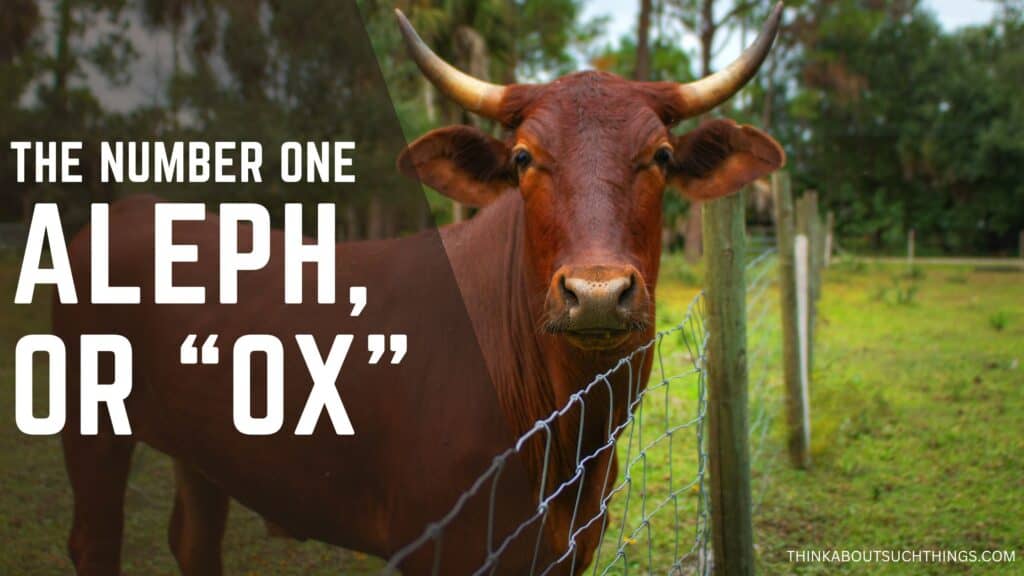

With that in mind, the symbol of the ox refers to a few meanings that we can associate with the number 1:
- Strength: Oxen were strong animals that assisted with manual labor.
- Leadership: Whether moving a caravan or tilling the soil, oxen lead the procession. Where more than one ox was used, one of them would take the lead. That’s the ox that Aleph (one) refers to.
The Different Hebrew Words For “One” In The Bible
“I do not pray for these alone, but also for those who will believe in Me through their word; 21 that they all may be one, as You, Father, are in Me, and I in You; that they also may be one in Us, that the world may believe that You sent Me. – John 17:20-21
There are two ancient Hebrew words that mean “one.” The first one we will look at is “yachid” or “yacheed.” This word is usually referenced for solitary, like the word “my one and only daughter.“
יָחִיד yâchîyd, yaw-kheed’; from H3161; properly, united, i.e. sole; by implication, beloved; also lonely; (feminine) the life (as not to be replaced):—darling, desolate, only (child, son), solitary.
Hebrew: Echad
The second Hebrew word is “echad.” It refers to a compound unity, similar to one interpretation of “yacheed.” But it more specifically refers to a single, all-encompassing object. Only one, a unique one, and no others exist. An example is the verse in Deuteronomy 6:4, which says, “Hear, O Israel: The LORD our God, the LORD is one.”
“echad” refers to the fact that there is only one true God.
It also means perfect unity. This is the type of unity between a husband and wife, between God the Father and the Son, and the type of unity Jesus prayed for us as believers to have in John 17:20-21. It’s a unity that’s so perfect that there is only one recognizable entity. A tall order, to be sure, but that’s what we should be aiming for.
אֶחָד ʼechâd, ekh-awd’; a numeral from H258; properly, united, i.e. one; or (as an ordinal) first:—a, alike, alone, altogether, and, any(-thing), apiece, a certain, (dai-) ly, each (one), eleven, every, few, first, highway, a man, once, one, only, other, some, together,
I like what Bible.ca says about echad:
“Instead the Holy Spirit chose to use the Hebrew word, “echad” which is used most often as a unified one, and sometimes as numeric oneness. For example, when God said in Genesis 2:24 “the two shall become one [echad] flesh” it is the same word for “one” that was used in Deut 6:4.” (source)
For example, the singular sacrifice of Jesus, as we can see in 1 Tim. 2:5 and John 10:16. That one sacrifice was enough to cover all the world’s sins and ensure redemption for all who believe.
One God, one Son in unity with one Father, and one sacrifice to cover all, to bind into one body all those who believe.
How The Number 1 Is Used In The Bible
There are a few notable ways that the Bible refers to the number 1 that can further explain its meaning. Another significant aspect to consider is the biblical symbolism of the number 2, which often represents duality and partnership. This is seen in the creation of Eve as a companion to Adam, highlighting the importance of relationships. Additionally, the number 2 can indicate the concept of testimony, as in the requirement of two witnesses to establish a matter, emphasizing unity and agreement in faith matters. Furthermore, the symbolism of the number four in scripture often signifies completeness and stability. For instance, it is represented in various contexts such as the four corners of the earth, which illustrates the totality of God’s creation. Additionally, the four living creatures described in the Book of Revelation point to the divine order and fullness in God’s presence.
The Oneness Of God
We already looked at Deuteronomy 6:4, which states the oneness of God. This verse, known as Shema, is such a fundamental part of Jewish life and faith that all devout Jews recite it daily to affirm their belief in the one and only God.
Jesus emphasized this in Mark 12:29 and again in John 10:30, where He says, “I and the Father are one.”
The Primacy Of God
In Revelations 1:17-18, Jesus declares, “I am the first and the last.” Again, in Revelations 22:13, He repeats this statement by saying, “I am the Alpha and Omega, the first and the last, the beginning and the end.”
God is Prime. He was there before anything else was and will still be there after everything ends.
This meaning of the number 1 is further emphasized when we consider that 1 is the only number that is perfectly divisible from all other numbers. It forms part of every other number; no others would exist without it. Yet it can also stand independently with no other numbers to represent or accompany it.
There’s a reason why God repeatedly says that He is One. It doesn’t only refer to His singular nature but also to the fact that everything exists because of Him. He is both part of and separate from everything that exists in the world.
The One And Only Son Of God
The very famous John 3:16 says, “For God so loved the world, that He gave His only Son, that whoever believes in Him should not perish but have eternal life.” As mentioned, the word “one” refers to something unique, the only of its kind. Jesus is the Father’s one and only Son, which ties in with His use of the words “first” and “Alpha” in Revelations.
This emphasizes that there can be one Jesus. He is the only One.
Unity In The Body Of Christ
We’ve seen how Jesus used the word “one” when He prayed for His disciples to be one in John 17:20-21. He included not only those who were following Him at the time but also “…those who will believe in Me through their word.” Jesus prayed that all of us, even those of us who believe today because of the word of the original Apostles, would be one.
Paul emphasized this in 1 Corinthians 12:12-13 where he said, “For just as the body is one and has many members, and all the members of the body, though many, are one body, so it is with Christ. For in one Spirit we were all baptized into one body – Jews or Greeks, slaves or free – and all were made to drink of one Spirit.”
We are meant to act as one. That does not mean there won’t be disagreements; Paul and Peter had notorious conflicts. It seems that few people in the young church could get along with Paul. But, in the end, they served the same Lord and God and had the same goal: furthering the Kingdom of God by preaching the gospel.
If we can set aside our differences and start to work together as God intended, we will see the Kingdom manifest as never before.
The Spiritual Meaning Of The Number 1
We have explored the number 1 in the Bible and learned some interesting things. Now it’s time to round up the number’s spiritual or prophetic significance and meaning. These three meanings really sum up what we have gone over. Among the notable aspects of biblical symbolism of the number 9 is its association with divine completeness and finality. It is often viewed as a number that signifies the fruits of the Holy Spirit, reflecting a deeper connection to spiritual enlightenment. Additionally, the number 9 embodies themes of faith and perseverance, reminding us of the importance of spiritual growth in our lives. the significance of the number 10 is equally profound in biblical texts. It is often seen as a symbol of divine order and completeness, representing the law and the covenant established by God. In addition to this, it serves as a reminder of the Ten Commandments, which guide moral living and foster a deeper understanding of our relationship with the divine.
Unity and Unification
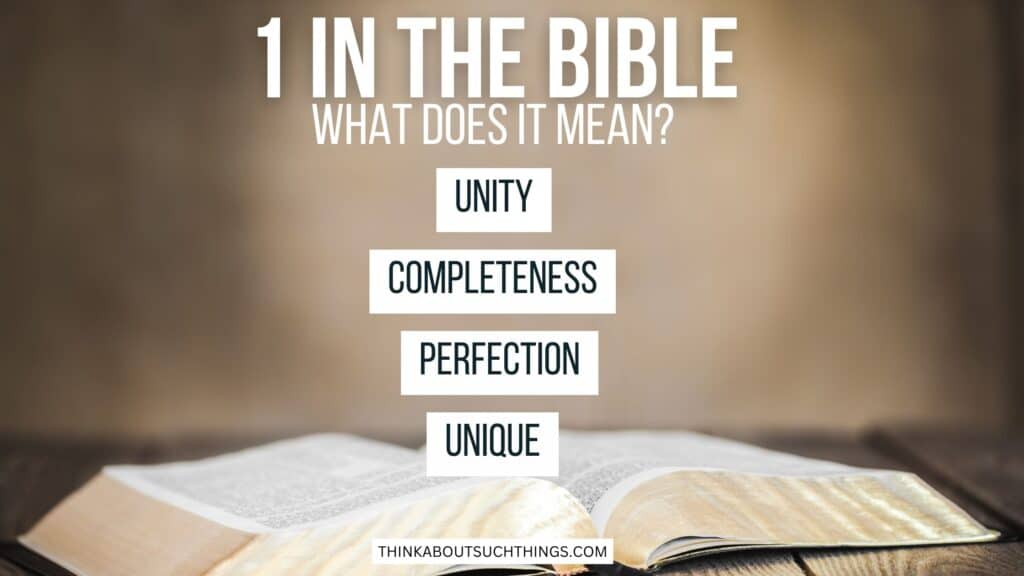
The number one is a powerful symbol of unity in the Bible. It is often used to represent the perfect and harmonious unity that exists between two or more entities. The number eight also carries significant meaning, often associated with new beginnings and resurrection in biblical texts. This symbolism of the number 8 in scripture highlights the idea of regeneration and the emergence of fresh life after cycles of completion. It serves as a reminder of God’s promises and the potential for renewal in the lives of believers. the biblical symbolism of the number twelve is equally profound, often signifying divine authority and governance. This number is frequently associated with the twelve tribes of Israel and the twelve apostles, each representing a foundational aspect of faith and community. Through these connections, twelve reinforces themes of completeness and the guidance of God in the lives of His people.
IT symbolizes the perfect unity between the Father and Son. Jesus said, “I and My Father are one” (John 10:30). This is an example of spiritual unity that transcends all boundaries. Furthermore, the number one is also used to depict the marital union between husband and wife.
When God created Adam and Eve, He proclaimed that they were “one flesh” (Genesis 2:24). Jesus also taught about this union in Matthew 19:6 by saying, “what therefore God has joined together, let not man separate.”
The number one is a powerful reminder of the deep level of unity expressed throughout scripture, both among people and with God.
- Unity between the Father and the Son – (Jn. 10:30)
- Unity between husband and wife – (Genesis 2:24; Matthew 19:5)
Completeness and Perfection
The number one is a key symbol in the Bible that is often used to signify completeness and perfection. It is often seen in regard to God’s oneness, emphasizing that He is complete within Himself.
Uniqueness
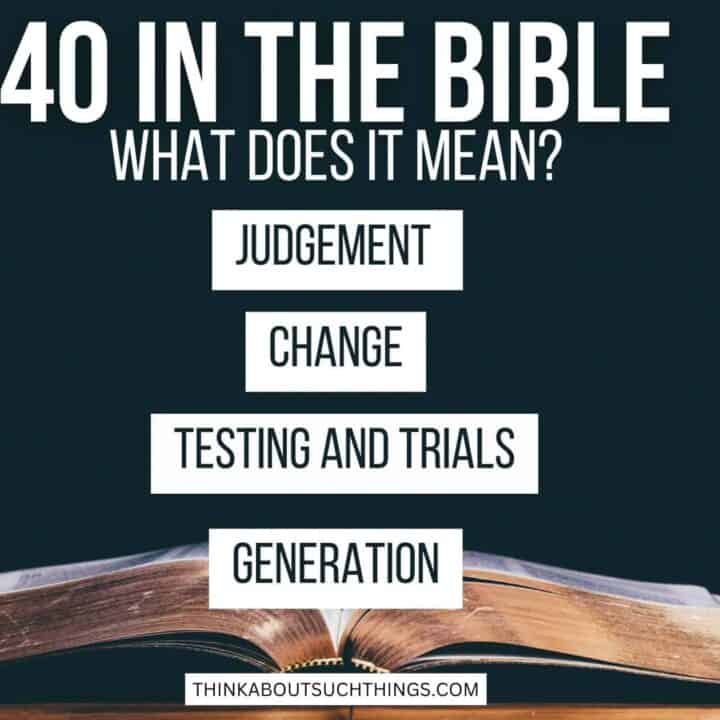
The number one in the Bible is symbolic of uniqueness. It represents God’s absolute sovereignty and power as He stands alone above all other gods and religions. The number one also symbolizes the singularity of Jesus’ sacrifice. As written in 1 Timothy 2:5, Jesus was the “one mediator between God and men.” In contrast, the spiritual significance of number 5 is often seen as a representation of grace and God’s goodness. It also symbolizes the five wounds of Christ, highlighting His sacrifice and the love He showed for humanity. Additionally, number 5 is linked to the idea of divine protection and favor, underscoring a deeper connection to spiritual revelations. The significance of 40 in scripture is often associated with periods of testing and trial, as seen during the 40 days of Jesus’ fasting in the wilderness. Moreover, the Israelites wandered for 40 years in the desert before reaching the Promised Land, representing both a time of purification and preparation for a new beginning. This number frequently appears in biblical narratives, emphasizing its important role in the spiritual journey and growth.
Numbers of the Bible Series
Have you ever been curious about the numbers used in the Bible? Me too! That’s why I’ve recently embarked upon a series of articles that shines a light on numbers in the Bible.
The goal is to explore their symbolic and spiritual meaning, discovering deeper truths from Scripture. Check out my articles below if you’re interested! I’m sure you’ll learn something new along the way! Many people wonder about the biblical significance of numbers explained, as these figures often hold profound meanings that can enhance our understanding of scripture. By delving into these numbers, we can uncover layers of wisdom that have been passed down through generations. I invite you to join me on this enlightening journey as we explore each number’s unique role and the messages they convey.
Numbers in the Bible Series


















Whenever we see the number 1 in scripture, we can remember that God is One and that He is Prime in all creation, and he is above all we face and over every challenge. We can also remember that Jesus, as the only Son of God, made the ultimate sacrifice so that we can be one with Him and our fellow believers. Only then will we be able to accomplish the task He set before us.


Melissa is a passionate minister, speaker and an ongoing learner of the Bible. She has been involved in church and vocational ministry for over 18 years. And is the founder of Think About Such Things. She has the heart to equip the saints by helping them get into the Word of God and fall more in love with Jesus. She also enjoys family, cooking, and reading.
She has spoken in churches in California, Oregon, Texas, and Mexico and has been featured in Guidepost Magazine and All Recipes Magazine. Read More…