
In this article, we will continue our understanding of the numbers of the Bible. This time we will look at the Biblical meaning of the number 10. So, grab your Bible and let’s dig in…
Every word in the Bible is inspired and is there for a reason. That means that there is significance to numbers that frequently appear in the Bible. Not every number in the Bible has a deeper meaning, but when numbers appear repeatedly, we should consider the reason, message, or significance.
Biblical numerology looks at the significance or meaning of a number based on the use of numbers in the Bible. Biblical numerology examines how and when a number is used to better understand God’s word. the biblical significance of the number seven is particularly noteworthy, as it appears frequently throughout scripture, symbolizing completion and perfection. For instance, God rested on the seventh day after creation, marking it as holy and significant. This recurring theme invites deeper reflection on the divine structure and order inherent in the universe. Furthermore, the biblical symbolism of the number 7 extends beyond just creation, as it often represents a covenant between God and humanity. It is seen in various contexts, such as the seven days of the Feast of Unleavened Bread or the seven trumpets in the Book of Revelation, highlighting its significance in spiritual journeys and divine promises. This number continues to resonate within religious practices and communities, emphasizing the importance of completion and divine perfection in believers’ lives.
We also see the number ten as a combination of other numbers that can add meaning to the message. For instance, four speaks of creation plus six, symbolizing man, which adds up to ten and shows God’s complete work. Or five shows God’s grace multiplied by two bearing witness to His grace. The meaning becomes clearer by looking at a few of the many instances where ten occurs in God’s Word. The symbolism of the number 5 in scripture often points to God’s favor and the covenant relationship He establishes with His people. It is significant that the number appears in various contexts, such as the five books of the Torah, which lay the foundation for the law and the relationship between God and Israel. Additionally, five loaves of bread were used to feed the multitude, demonstrating God’s provision and abundance through seemingly insufficient means.
10 in the Bible: A look at the Hebrew Letter Yod
The tenth letter in the Hebrew alphabet is the Yod. It is the smallest letter in the alphabet, but Jesus mentions it along with the tiny brush strokes in the alphabet. If it was important enough for Jesus to mention the detail of every Yod and tittle, then we should pay heed to them.
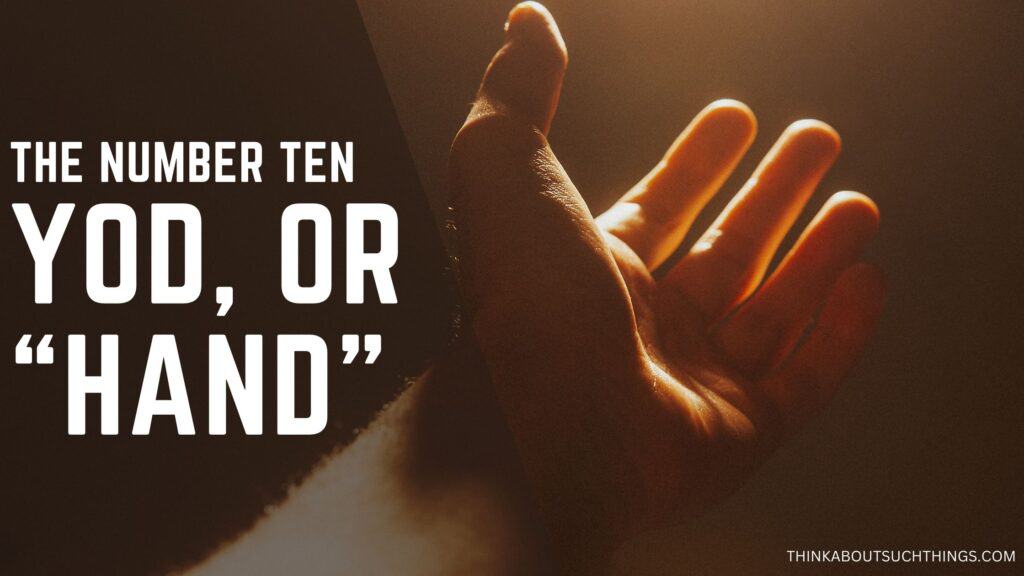
When we examine the pictographic meaning of the Yod, we learn that it represents a hand or work.
It also represents worship, congregation, and power. As part of the LORD’s name, the Yod represents God’s powerful hand and deeds worthy of our worship. This fits with the number ten, representing perfection and divine order.
The Biblical Meaning Of The Number 10
10 Commandments In The Bible
Before the law, there were instances of transgressions that had generational consequences. For example, the consequences of Adam and Eve’s transgression and when Cain killed Able. The law made obedience to God personal. Each person could obey or overstep the mark in a personal capacity, and it made God’s expectations clear. The law also shows us that we cannot keep all of God’s commands as we are imperfect.
The ten commandments indicate God’s divine order encompassing man’s relationship with God in the first four commandments. The following six commandments detail God’s instructions for our actions toward our fellow man. If man could follow the ten commandments to the letter, there would be peace and order on earth. In this sense, ten indicates God’s divine order.
You can read all 10 commandments in Exodus 20.
10 Plagues In The Bible
for at this time I will send all My plagues to your very heart, and on your servants and on your people, that you may know that there is none like Me in all the earth. – Exodus 9:14
The number ten can represent God’s judgment. We observe this in the Exodus account of the ten plagues God brought to bear on the Egyptians. The judgment was due to the pharaoh refusing to release the Israelites from bondage. God proved His authority over man and creation by using nature. The ten plagues show the complete judgment of God, as stated in Exodus 9:14. In contrast, the biblical significance of the number six often symbolizes imperfection and incompleteness, which can be seen in various contexts throughout scripture. For example, mankind was created on the sixth day, a number that falls short of the divine perfection represented by seven. Additionally, in Revelation, the number six is associated with the mark of the beast, further emphasizing its connotation of human failure and rebellion against God’s order.
We also see God’s grace in these accounts, though. We read in Proverbs 26:2 that “the curse causeless will not come.” Similarly, God did not cause the plagues to come upon his people. We see that God made light shine within the homes of the Israelites despite the darkness outside.
The Pure Lamb To Counter the 10th Plague
In this same Exodus account, we learn that the last of the ten plagues would kill every firstborn offspring in the land. But because God is just and does not pour out judgment without cause. He made a way to prevent harm to those who obey him.
God instructed each family to bring a perfect male lamb into their homes on the tenth day of Abib. They were to inspect it and care for it lovingly for four days. On the evening of the fourth, the lamb was to be killed, and its blood was to be painted on the doorposts of each house. The blood was a sign of obedience to God’s instruction, and as such, the angel of death would pass over such a marked house.
We can learn from this account that God is gracious and makes a way to prevent harm to those who obey Him. This message is reinforced by the markings of the blood on the door post forming the Hebrew letter Heh. This letter has the numerical value of five, symbolizing grace. The blood witnessed God’s grace in the midst of judgment. The significance of the number 40 can also be seen in various biblical narratives, often representing a period of testing or a significant transition. For instance, the Israelites wandered in the desert for 40 years as a means of spiritual refinement, preparing them to enter the Promised Land. This pattern emphasizes that through trials, God provides guidance and sustenance for those who remain faithful.
The Number 10 And God’s Creation
We find the phrase God said ten times in the first chapter of Genesis. He created the earth (four) and man (six) with these ten statements and observed that they were very good. God observed His complete and sinless creation with its divine order, which was very good. The spiritual significance of the number 12 is often highlighted in religious texts, symbolizing completeness and divine authority. In the Bible, the number appears frequently, such as in the twelve tribes of Israel and the twelve apostles chosen by Jesus. This sacred number underscores the idea of a divine plan and order in creation, enhancing our understanding of God’s purposeful design. The biblical significance of number four can be seen in various instances throughout the scripture, where it often represents completeness and stability. For example, there are four cardinal directions—north, south, east, and west—that denote the fullness of the earth. Similarly, the four living creatures described in the Book of Revelation embody a picture of divine order and perfection within God’s creation.
This instance of the number ten shows God’s perfection in creation. It is this hope of peace and eternal perfection that we strive for and look forward to as Christians. We cannot attain it through our works or by the law. So how do we attain the divine order God said was very good in our lives? The biblical significance of the number 2 highlights the importance of duality, such as the union between God and humanity or the connection between faith and works. Understanding this concept can lead us to a deeper appreciation of God’s design for relationships and community. By recognizing these pairs in our lives, we can align ourselves more closely with the harmony that God intended. The biblical significance of the number three often represents completeness and divine manifestation, as seen in the Holy Trinity of Father, Son, and Holy Spirit. This triadic structure is reflected throughout scripture and serves as a reminder of God’s presence in our lives. By embracing these facets of faith, we find strength and unity in our spiritual journey.
10 Tests And Challenges
Sometimes our everyday circumstances make us forget God’s faithfulness. We get caught up in the current situation and do not fall back on God’s word as a way to face our future. This is what the Israelites experienced when they left Egypt. They experienced God’s power through the ten plagues. They walked through the Red sea as if through dry land. Despite God’s miracles, they focused only on their present.
As a result, the Israelites rebelled ten times while in the wilderness and chose to believe the ten spies’ negative report rather than the two’s faith-filled report. Through this rebellion, they showed unwillingness to submit to God. This resulted in them wandering in the desert rather than entering the promised land God had prepared for them.
We have another example of 10 tests that changed a person’s character so much that God changed his name. Jacob’s name means supplanter because he took his twin brother’s birthright by deception. Jacob had to flee from his brother and went to live with his uncle Laban. Jacob learned something about cunning from Laban, who deceived him and amended his wages ten times.
Jacob learned to trust in God rather than in man through this process. Before Jacob needed to face his brother twenty years after stealing his birthright, he had an encounter with God. God changed Jacob’s name to Israel, which means God prevails. Through the ten trials, Jacob trusted God’s divine plan and received an abundant reward because of his faithful obedience.
Jesus, Our Passover Lamb
Just as the Israelites had to take a blemish-free lamb into their homes on the tenth day of Abib (also called Nisan), Jesus rode into Jerusalem. During the next four days, the Sanhedrin scrutinized Jesus. In God’s perfect numbering, six people find Jesus blameless during these four days.
The Yod, the smallest letter of the alphabet, symbolizes work or a hand. This imagery fits in perfectly with Jesus being our Passover Lamb. His hands, nailed to the cross, became part of the completed work that set us free so we could commune with God again.
Jesus became the blameless Lamb that redeemed us out of bondage. His Blood has set us free. Through His willing sacrifice and victory on the cross, Jesus provides a way for us to walk in completeness and divine order. What we cannot do through our works, Jesus did for us, and He has the scars on His hands to prove it.
Other Mentions of The Number 10 In The Bible
- Ten generations between Adam and Noah, then another ten generations from Noah to Abraham. (Genesis 6:5-8, Genesis 11:10-26)
- Daniel, Shadrach, Meshach, and Abednego were considered to walk in a spirit of excellence, and it is said that they were 10 times better! (Daniel 1:20)
- There are 10 I AM statements that Jesus made in the gospel of John.
- In the Old Testament, we start to see the use of 10% or the tithe given unto the Lord. (Leviticus 27:32)
The Spiritual Meaning Of 10
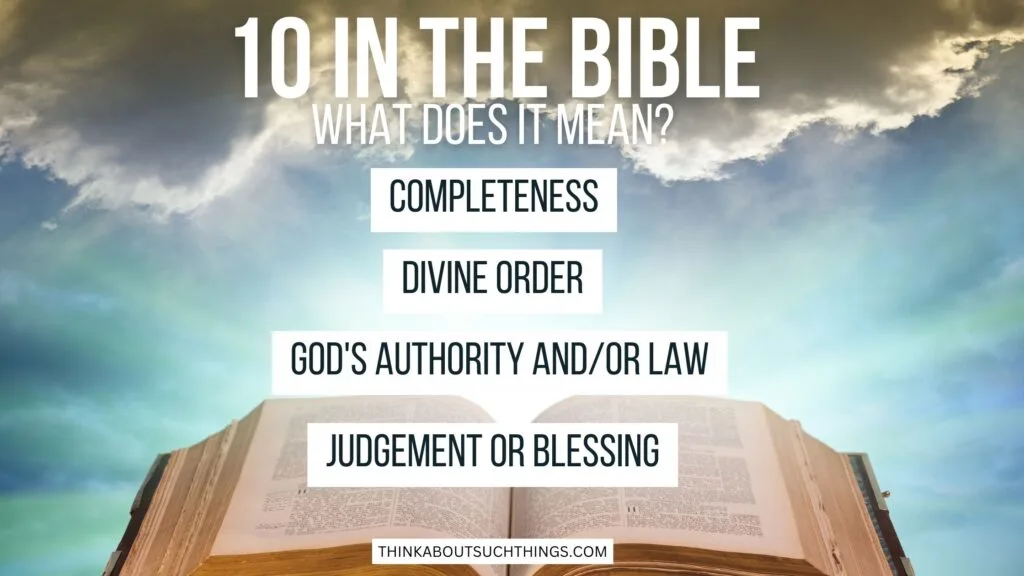
To recap or sum up the spiritual, Biblical, or prophetic meaning of the number 10. The number ten is found throughout the Bible and signifies completeness, divine order, judgment, or blessings. A tenth part is considered representative of the whole object, as in the case of tithing the fruits of one’s labor. The number ten symbolizes our responsibility and obedience to God’s commandments. Exploring the biblical significance of the number 1 reveals its representation of unity and primacy. This number serves as a reminder of God’s sovereignty and the essential oneness of faith. In many instances, the singularity of God is emphasized, as seen in the commandment, “You shall have no other gods before me.
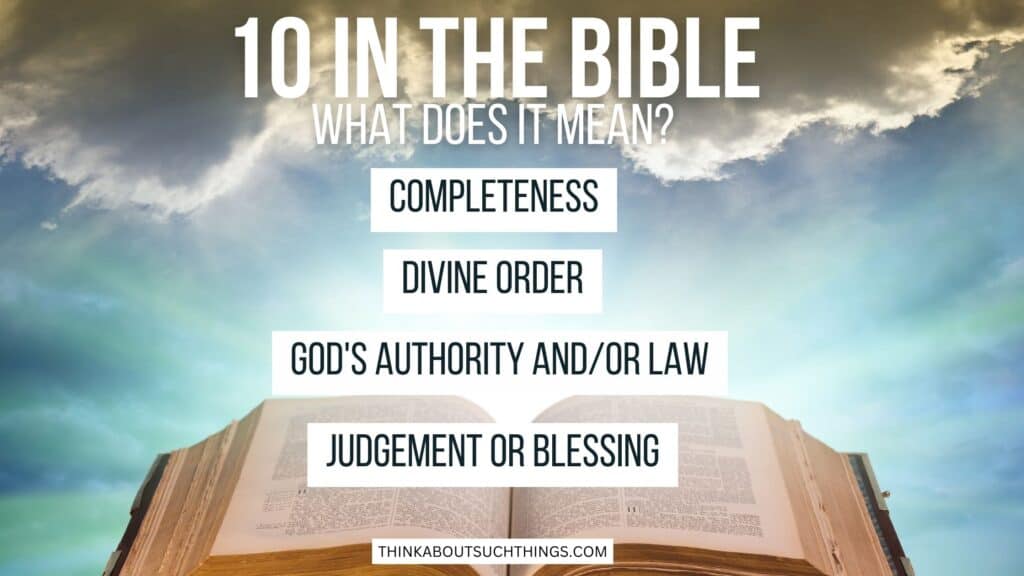
The symbolism of the number 10:
- Completeness
- Judgment or Blessing
- God’s Law or Authority
- Divine Order
Numbers of the Bible Series
I’ve been working hard on this series – it’s all about numbers in the Bible. Seriously, being able to explore the depths of scripture through something like numbers is so interesting and fruitful. Not only does it help to give us insight into God’s plan and Word, and it helps remind us that He’s in control of everything! In addition to studying numerical symbolism, exploring biblical interpretations of dreams can shed light on personal and collective experiences. These interpretations often reveal deeper meanings and connections to the divine, encouraging believers to reflect on their own spiritual journeys. Through these insights, we can gain a richer understanding of how God communicates with us in the modern world.
Numbers in the Bible Series

















The biblical meaning of the number ten is complex and speaks about perfection and completeness. These are two attributes that man can not attain without God’s intervention. The number ten also reminds us that by God’s work and His hand, we can live in His divine order. The spiritual significance of the number 9 often highlights themes of wisdom, initiation, and spiritual awakening. It serves as a reminder of the journey towards enlightenment, emphasizing the importance of selflessness and compassion. Just as the number ten signifies completeness, the number nine prepares the soul for transformation and deeper understanding. The biblical significance of the number 8 is often associated with new beginnings and resurrection, symbolizing a fresh start in one’s spiritual journey. This number emphasizes renewal and the promise of eternal life through faith and divine mercy. In many biblical accounts, the number 8 serves as a reminder that transformation and rebirth are possible through God’s grace, aligning with the themes of hope and restoration found throughout scripture.


Melissa is a passionate minister, speaker and an ongoing learner of the Bible. She has been involved in church and vocational ministry for over 18 years. And is the founder of Think About Such Things. She has the heart to equip the saints by helping them get into the Word of God and fall more in love with Jesus. She also enjoys family, cooking, and reading.
She has spoken in churches in California, Oregon, Texas, and Mexico and has been featured in Guidepost Magazine and All Recipes Magazine. Read More…